New Connections: Our Future Music Leaders Are Inclusive and Adaptable
NewsNews Story
Claire Henderson, Community Impact Coordinator - North, on New Connections, our partnership programme with Leeds Conservatoire and Manchester Camerata, that combines student music leadership training with creative projects in local schools.
“How would you adapt this musical exercise for different abilities?”
When this was the first question asked by the Leeds Conservatoire students at the beginning of their skills development programme, I knew we were off to a great start with a group that was receptive to training on music leadership skills.
New Connections is an action-based learning programme on music leadership, in partnership with Leeds Conservatoire. It equips students with their own creative toolkit and teaches them about best practice in collaboration, inclusivity, and adaptability, so that they can develop their musical skills to work effectively in a range of settings with different ages.
With this being my first experience of New Connections, I didn’t know what to expect from the students’ engagement. The sessions explored co-creation, inclusive practice and creative health - key pillars of collaborative creative work with people. I was curious about how developed their thinking already was around these ideas, and how they understood their musicianship as a tool for working in community and youth settings.
However, the most important factor in doing this work justice was already present in the room, demonstrated on the first day of the programme through the students’ attitudes and the questions they asked.
“Being considerate of how to include all abilities, and beginning to think about adaptations, starts with an inclusive attitude - something this cohort of New Connections students clearly demonstrated.”
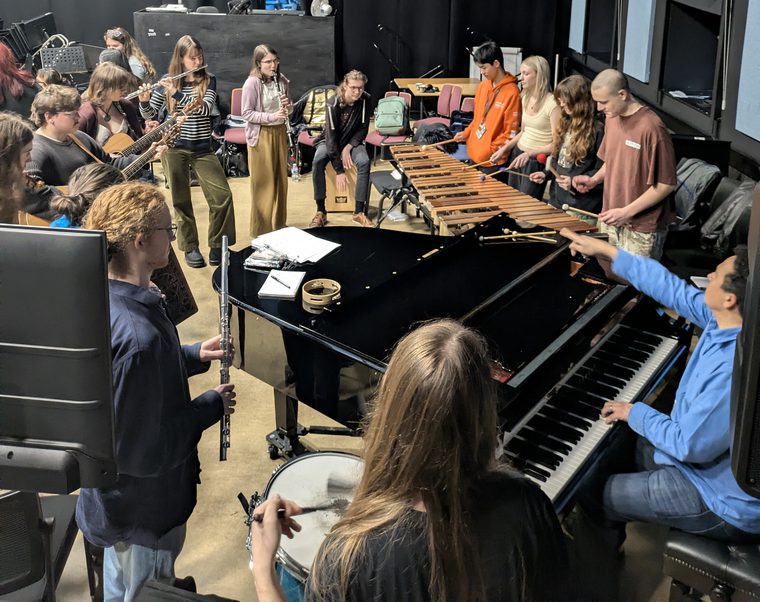
Pete Letanka with students at New Connections Skills Day, 2025
Credit: Claire HendersonThe skills programme this year was led by Pete Letanka - a writer, composer, and jazz pianist with a wealth of experience working in schools, communities, prisons, and performing around the world. Alongside Pete, Leeds-based charity Made with Music led a session on early years music making, and Manchester Camerata led an introduction to their award-winning ‘Music in Mind’ training which underpins their work in creative health.
Through conversations across the sessions, artists shared some key tips with students:
Don’tbe bashful: Playing at a professional level isn’t about showing off, but more about using your musical expertise to support others to find their instrument and sound.
Understand that everyone’s voice is important: Leading a music-making session is not about coming up with the best ideas for lyrics and pieces, but about finding the best way to encourage others to offer their own ideas and stories.
Practice good dialogue: Communication skills are vital in facilitating people to feel comfortable and excited to share their ideas, whether they have a musical background or not. When everyone feels comfortable sharing their ideas, it means that the outcomes – be it a new piece of music, musical development, or just a connection to a story, person or place - can be explored and celebrated by us all.
Training is crucial: Students are pursuing placements, teaching, and freelance work, and the New Connections programme equips them with the skills and understanding to feel more confident as emerging artists. This enables them to jump at these opportunities and step into these experiences with professional tools in both music making and interpersonal skills.
You must enjoy it: Enjoyment means young creatives will continue to pursue their line of work, even during the more challenging times. Music leading and collaborative music making then becomes another way to simply enjoy your instrument and craft.
“When imagining the future workforce of musicians, music leaders, and creative producers – the picture is a hopeful one.”
It may be a broad generalisation, but one I am comfortable making: younger generations are equipped with inclusive attitudes, and actively champion diversity. Society and the arts may still have a long way to go, but with these creative thinkers at the helm, there is much to be hopeful for.