Why Storytelling Matters Just As Much As Statistics
NewsNews Story
At Orchestras Live, we’ve always gathered the numbers: how many people took part in our projects, how many sessions we delivered, how many schools or partners were involved. That quantitative picture is essential — it helps us understand scale, track activity and demonstrate reach. But over time, we’ve realised that numbers alone can’t show the real depth of change that happens when people take part in creative work. They tell us what happened, but not why it mattered.
What qualitative approaches bring into focus
This is where qualitative evaluation becomes invaluable. Through approaches such as Most Significant Change and our Storytelling Evaluation Method, we create space for participants to describe their experiences in their own words. These are simple, guided conversations that begin with open questions — What changed for you? Why was that significant? — and follow wherever the storyteller leads. There are no predefined measures or expected outcomes. Just people reflecting honestly on what the project meant to them.
What emerges is often rich, surprising and deeply human. A child discovering confidence through rehearsals. A creative practitioner feeling a renewed sense of belonging. A young person realising they can achieve something they didn’t think they were capable of. A community participant finding joy in working alongside professional musicians. These are the kinds of shifts that rarely appear in survey stats, yet they shape how people feel, how they participate and how they take the experience forward.
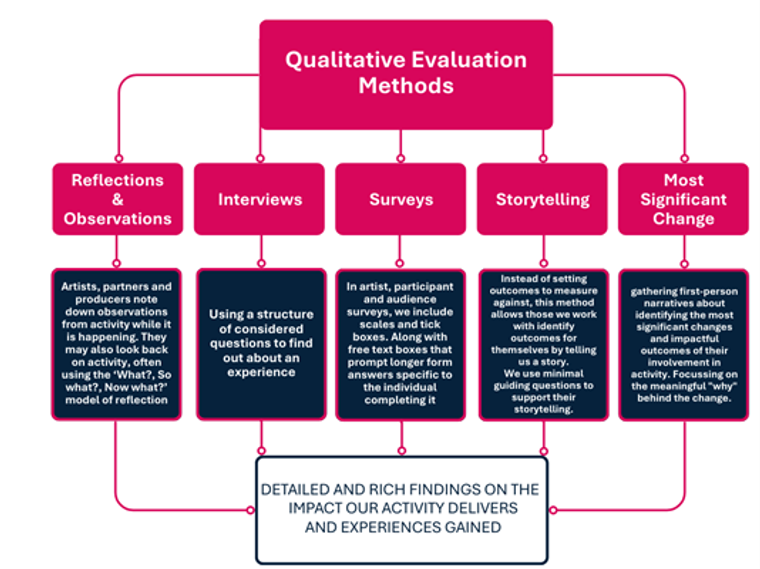
Above: A flowchart of the qualitative evaluation methods we utilise across Orchestras Live programmes and projects.
How this changes the way we evaluate
Qualitative methods also change the nature of evaluation itself. Instead of something administrative, it becomes something shared — a process that values relationships, trust and reflection. Participants feel heard; practitioners gain insight into what really worked; partners see the human stories behind the statistics. And for us, these stories help shape future projects, revealing not just the impact we hoped for, but the impact we didn’t expect.
As we’ve continued to use storytelling for evaluation across our programmes, we’ve also learned that it needs to be treated as a project in its own right. Collecting stories takes time, care and collaboration, and it asks us to hold a real responsibility towards the people who share their experiences with us.
The process works best when it is planned for from the outset, with space for relationship‑building, thoughtful facilitation and shared reflection. Each cycle teaches us something new — about how we listen, how we gather information, how we respect someone’s voice, and how we bring those insights back into our organisational learning. It has also opened up new questions for us: how might we adapt storytelling for group settings, or weave in other creative mediums? What other evaluative approaches might sit alongside it to help us understand where change happens? This reflective practice is helping us refine the methodology and ensure it continues to evolve in a way that feels ethical, responsive and true to the communities we work with.
A fuller, more honest picture of impact
When we bring qualitative stories together with quantitative data, we gain a fuller understanding of our work. The numbers show the breadth; the stories show the depth. Together, they help us understand not only what happened, but how and why change took place.
What’s coming in our LinkedIn series
Over the coming weeks, our LinkedIn series will take a closer look at how these approaches work in practice. We’ll be sharing examples from across our regions — including children’s experiences in the Long Shop Sound Machine project in the East, creative practitioner perspectives from Voices of Bolsover in the Midlands, and young people’s stories from Our Music, Our Way in the North.
We’ll also unpack the methods themselves, exploring how Most Significant Change is collected, titled and edited, and how our Storytelling Evaluation Method has been developed and adapted within Orchestras Live. Together, these posts will offer a deeper look at the human stories behind our work and the learning that continues to shape our evaluation practice.
Where Numbers End and Stories Begin: How We Understand The Whole Impact of a Creative Project
Our Most Significant Change Approach
The Storytelling Evaluation Method
Listening to Impact - The Long Shop Sound Machine Case Study